While gold usually gets all the attention in Indian households, silver has quietly become a powerhouse for wealth creation. In 2025 alone, silver surged by roughly 168%, actually outperforming almost every other financial instrument. It is no longer just a metal for jewellery; it is a strategic asset with record-breaking industrial demand.
If you are looking to diversify, here is a breakdown of how you can invest in the “second metal” today.
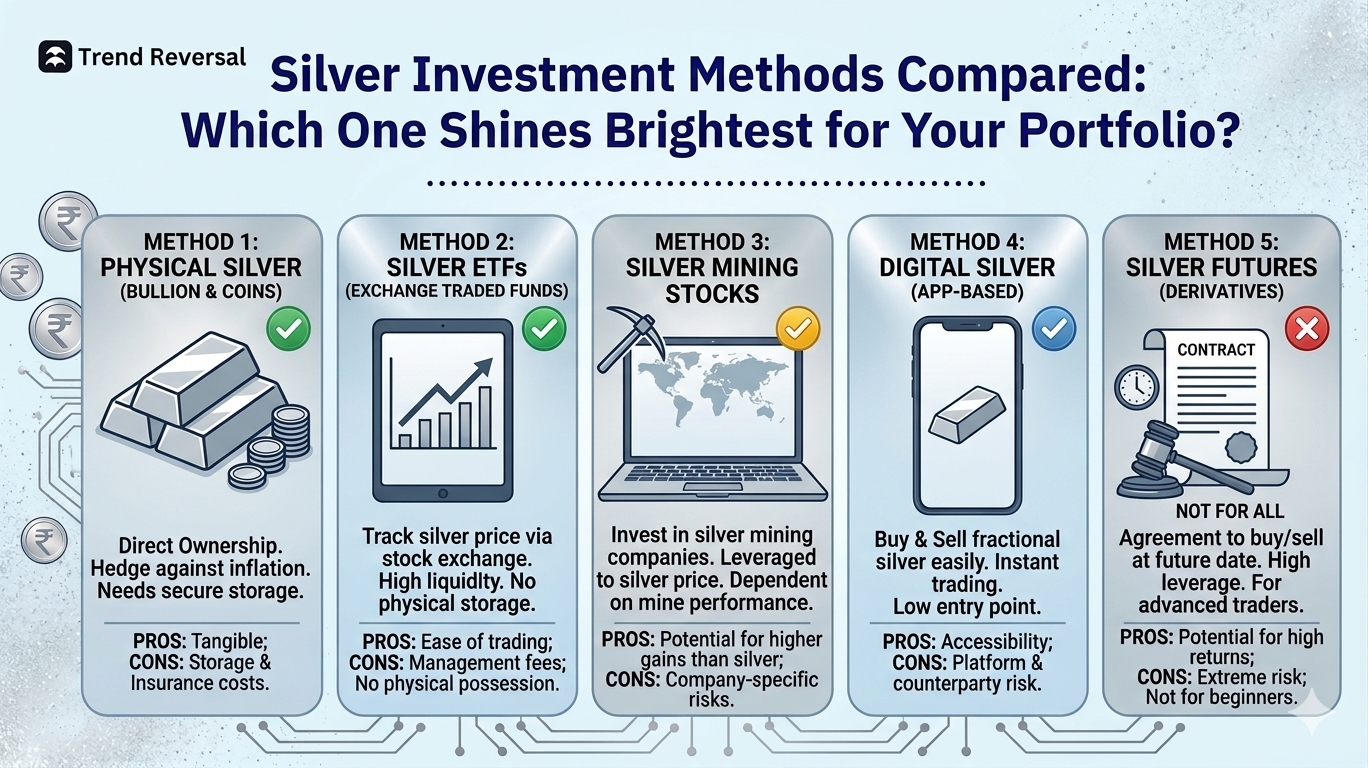
1. Physical Silver: The Tangible Classic
For most of us, silver starts with jewellery, coins, or bars.
The Vibe: There is a certain comfort in holding a heavy silver bar or gifting a coin during Dhanteras.
The Reality: Buying physical silver means paying 3% GST and often 5% or more in making charges. You also have to worry about storage, theft, and the cost of bank lockers.
2. Silver ETFs (Exchange Traded Funds): The Modern Professional
If you want to treat silver like a stock, ETFs are the way to go. These are SEBI-regulated funds that track domestic silver prices.
Why they work: They are backed by 99.9% pure silver bullion kept in secure, audited vaults. You don’t need to worry about someone “faking” the purity.
Liquidity: You can buy or sell them instantly on the NSE or BSE using your demat account.
3. Silver Fund of Funds (FoF): The “Pocket-Friendly” SIP
Don’t have a demat account? No problem. Silver FoFs invest in silver ETFs on your behalf.
Affordability: You can start a Systematic Investment Plan (SIP) for as little as ₹100. It’s the easiest way for a beginner to start building a silver portfolio without a large upfront cost.
4. Digital Silver: Convenience with a Warning
Digital silver lets you buy small amounts through apps, which is then stored for you.
The Risk: Unlike ETFs, digital silver is not uniformly regulated in India. SEBI has even issued cautions to the public, noting that these instruments can carry significant risks.
5. Silver Futures: The High-Stakes Game
This involves locking in a price today for a transaction later. It is highly risky and generally best left to experienced traders who can handle the market’s “swings”.
Beyond the Sources: What You Should Know
The following information is not contained in the provided sources and should be independently verified:
The “Green” Driver: Beyond solar panels, silver is essential for Electric Vehicles (EVs) and 5G infrastructure because it has the highest electrical conductivity of any metal.
Volatility: Silver is historically more “jumpy” than gold. Because the silver market is smaller, a little bit of buying or selling can move the price significantly.
The Silver-Gold Ratio: Professional investors often look at the price ratio between gold and silver. When the ratio is very high, it often suggests that silver is “cheap” relative to gold.
Quick Comparison: Which One Fits You?
Feature
Physical Silver
Silver ETFs
Silver FoFs
Digital Silver
Regulation
Regulated Sellers
SEBI Regulated
SEBI Regulated
Unregulated
Purity
Check manually
99.9% Assured
99.9% Assured
Varies
GST
3% on purchase
No GST
No GST
May apply
Minimum
Cost of coin
1 unit (~1g)
₹100 (SIP)
Low
The Tax Man’s Share
Investing is only half the battle; you also have to consider what you keep.
Long-Term (LTCG): If you hold Silver ETFs or FoFs for more than 12–24 months, you are generally taxed at 12.5%.
Short-Term (STCG): If you sell earlier, gains are added to your regular income and taxed according to your income tax slab.
Is silver better than gold for investment?
Silver is more affordable—currently under ₹228 per gram compared to gold’s much higher price. While gold is a “safe haven,” silver often has higher growth potential during industrial booms due to its use in electronics and solar energy.
Can I get physical delivery of my Silver ETF?
Generally, no. ETFs are designed for price exposure and liquidity. If you want to hold the metal in your hand, buying silver bars or coins is the traditional route.
Do I need a lot of money to start?
Not at all. You can start with a ₹100 SIP in a Silver Fund of Funds. It’s a great way to “test the waters” without committing a huge sum.
Why is silver purity so important?
When you buy physical silver, purity can be a concern. Silver ETFs solve this by using 99.9% pure silver bullion stored with SEBI-approved custodians, so you know exactly what your investment is worth.